|
The Boston/ Cambridge/ Route
128 area might have some of the best conditions for
tech start-ups to thrive : Student brains, Universities,
capital, established businesses, incubators...
But according to Christian Perry, an entrepreneur who
specializes in producing networking events for start-ups,
the city's "old-school" social structure can
stymie young entrepreneurs.
"There's this artificial barrier on the East Coast
between work lives and personal lives," proclaims
Perry. "If you spent a couple of months in San
Francisco, you'd be invited to parties every night -
from karaoke to dinner parties to people's birthday
parties."
According to Perry, a 27 year-old who spent a few years
in Silicon Valley after college, this unstructured social
world is one of the things that makes Silicon Valley
a great incubator for tech companies.
"I've seen deals start to come together because
of drinks people have had," Perry said. "You
can say what you will about whether you have to be in
Silicon Valley, but at the end of the day, it's the
world's greatest technology ecosystem, and they do a
lot of things extremely well."
Perry argues, though, that there's nothing special
about Silicon Valley that makes that social structure
unique to the region. And he's trying to change what
he calls the "social exostructure" of the
high-tech community in Boston, and elsewhere, by importing
Silicon Valley's loose, horizontal structure to other
places.
"As much as we can, we want to take what makes
Silicon Valley work and bring it to cities everywhere
else," he said.
Perry's company, Beta
Ltd., hosts informal tech gatherings in over a half-dozen
cities across the country, and he recently held his
inaugural BostonBeta event at Kendall Square's Microsoft
NERD Center.
Trade show with Cupcakes, Fake Cash, and Booze
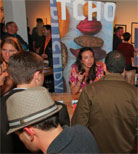
BostonBeta, a hybrid of a trade show, networking conference,
and a social event, drew nearly two hundred people from
within and around the tech community to the stylish
conference room of Microsoft's NERD Center. --
Perched at the edge of the Longfellow Bridge, and overlooking
the Charles River and the Boston night skyline, guests
were feted with Cosi coffee and cupcakes from Sweet
(itself a 2008 local startup). Cash bars on either end
of the room helped ensure that guests wouldn't mistake
BostonBeta for an "old-school Boston" business
function.
BostonBeta featured a friendly competition as well.
Each attendee was handed three poker chips upon entry,
and told that the chips each represented $10,000 to
be "invested" in companies of their choosing.
The companies with the most chips -- and the most investment
cash -- won bragging rights.
My first stop was at TurnStar
(which was called Textaurant before the event, and briefly
changed its name to Turnstar, and subsequently has changed
its name back to Textaurant), a company selling software
that allows restaurant hostesses to buzz patrons' phones
with text messages when their tables are ready (replacing
the often-bulky pagers restaurants have used for decades.)
TurnStar marketing manager Meredith Childs took a turn
demonstrating the software -- a couple of taps on her
iPad, and I started receiving text messages telling
me my table (at an imaginary BostonBeta restaurant)
would be ready soon.
Childs said she looks forward to events like BostonBeta
for the chance to introduce herself and her company
(which she'd joined a couple of months prior) to the
Greater Boston entrepreneurial community.
"If you don't get out there, no one's going to
know who you are," Childs said. "And it's
a great chance to practice your pitch."
Farrell McClernon was one of three employees manning
a booth for Privy,
a startup that helps companies embed coupon software
in their own web sites or Facebook pages.
Privy's booth scored a great location next to one of
the bars.
"This is prime real estate, man," she said.
"I know. I used to work in real estate."
Privy may not have needed the real estate to garner
attention. The company offers restaurants, salons, and
retailers the chance to offer rewards to their most
loyal customers directly (without a third-party site
like Groupon), and already has about 15 customers.
Dan Vidal, the co-founder of ArtVenue
-- a company that links artists with pieces to sell
with businesses who want art to display in their offices,
dining rooms, and retail spaces -- had even more confidence.
His young company already has 400 artists and over 30
businesses signed up - and within two weeks of launching
its pay system, the company had already processed two
dozen art sales (which earn the hosting business 20
percent commission - and ArtVenue 10 percent) .
Vidal even managed to sign a new business at BostonBeta.
"We just signed a bank an hour ago," he said,
about halfway through the event.
Competing for Attention
ArtVenue wound up winning BostonBeta's informal competition,
collecting $900,000 in Beta money (or, if you'd prefer,
90 poker chips) from the attendees. Privy and TurnStar
also scored highly. And while that competition was merely
for bragging rights, many of the companies featured
at BostonBeta came fresh from MassChallenge
(local incubator), which has evolved into one of the
premier events supporting Boston's burgeoning tech/startup
culture.
Vidal said he came up with the idea for his ArtVenue
just a week before the MassChallenge deadline, and had
to scramble to put together a business plan - but for
his trouble, he received a $50,000 Gold prize from MassChallenge.
While MassChallenge has higher stakes than BostonBeta,
the atmosphere is similar, with entrepreneurs and professionals
probing each others' businesses, asking tough questions
to try to make each other stronger.
I spent a few minutes at TapLab's booth, and heard
Bisceglia field questions ranging from "What games
did you play as a kid?" to "How can you make
REAL money playing this game?"
Could BostonBeta have preserved Facebook as a Boston
area startup?
Perry wants to make sure high-tech startups in Boston
have stronger resources. He said things are already
headed in that direction, "You see more incubators
opening, MassChallenge is becoming more popular. This
month, there was something going on [in Boston] every
day."
Even attendees who didn't have an official booth at
BostonBeta still had ideas to promote. Richard Bond,
a computer programmer attending as a guest, touted his
recent work-- building a live streaming website for
"Radio Bar," a new live music venue in Somerville's
Union Square.
He also underscored how important informal socializing
can be to a career in the tech economy. Bond told a
story of a group of young tech professionals he met
several years ago, who offered him a job programming
for a social media start-up.
The only catch -- he'd have to move to Silicon Valley
with them.
He declined.
A few months later, he started noticing the head of
that group of techies -- Facebook's
Mark Zuckerberg -- on magazine covers everywhere.
Discussing BostonBeta after the event, Perry pointed
to recent statements Zuckerberg made to Harvard students
as evidence that Boston can be a vibrant and successful
hub for entrepreneurs.
"If I were starting now, I think I would have
stayed in Boston," Zuckerberg said, explaining
that a lot of the startup culture in Silicon Valley
is far too short-term focused.
At the same time, Zuckerberg admitted that as a startup,
he only survived because of the resources that were
available in Silicon Valley to young companies in the
mid-2000s.
Perry hopes to continue his mission with another BostonBeta
event within the next couple of months, as soon as he
can finalize a date with the Microsoft Center. In the
meantime? He's busy launching DublinBeta.
|